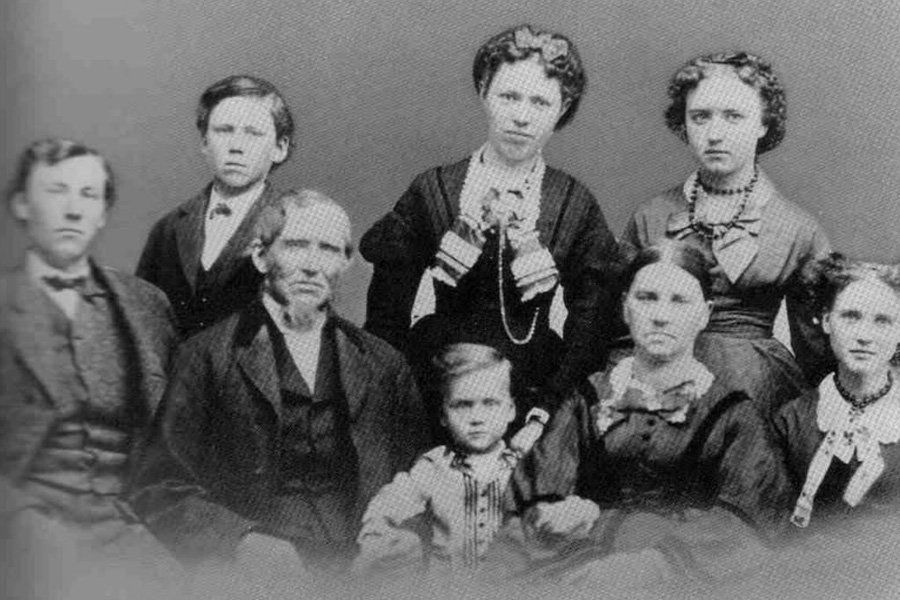
A household shaped by movement, memory, and work
I think James Mason Wilder belongs to that stubborn class of Americans whose lives were never built for applause. He was a man of acreage, weather, children, and duty. That may sound plain, but plain lives often hold the deepest weight. James Mason Wilder was born in 1813, and his world was one of fences, soil, timber, livestock, and the constant arithmetic of keeping a household alive. He did not live in the glow of fame. He lived in the friction of survival, where every season asked something different and every answer had to be earned.
What interests me most is that his story does not sit still. It spreads outward. A farm in northern New York became a family center, then a point of departure, then a memory that still gathers meaning. That kind of legacy works like roots under frozen ground. You do not always see it, but it keeps pushing.
More than a father in the shadow of literature
James Mason Wilder is often remembered because he was the father of Almanzo Wilder, but that narrow label misses the larger shape of his life. He was a husband twice over, a father to a full household, a landowner, and a link between older New England families and the later migrations that carried his descendants west and south. His importance is not only genealogical. It is structural. He helped create the conditions from which later Wilder lives unfolded.
I find that powerful because the farm was not simply a backdrop. It was a machine of endurance. It required clearing, mending, planting, storing, and planning. It demanded repetition, and repetition is one of the ways history is actually made. A fence repaired in spring, a barn used through winter, a child fed from a hard year, a mortgage paid, a field turned again and again. These are not dramatic scenes, yet they are the quiet engines of a family story.
The homestead itself eventually became a landmark in its own right. That matters because places can outlive the people who shaped them and still carry their fingerprints. The land remembers in its own way. A house can become a kind of vessel, holding not just boards and rooms, but habits, hardships, and the echo of voices long gone.
A family that branched in many directions
The Wilder household was larger and more varied than a simple father-son line suggests. James Mason Wilder and Angeline Albina Day Wilder had six children, and those children moved into different lives with different textures. Some stayed closer to the land. Some entered ministry. Some married and formed new households. Some became part of the wider American story through settlement, movement, and writing.
That variety matters. It shows me that the family was not frozen in one identity. It was a living web. One branch pointed toward religion and mission work. Another pointed toward the pioneer West. Another moved into the memory world of literature. Another remained tied to home and place. The family was like a tree growing in several weather systems at once, each limb tested by a different wind.
Royal Gould Wilder stands out because he became a missionary in India, which adds a global dimension to the family history. That one fact opens the frame. A boy raised in the atmosphere of a rural American farm later moved into a mission field across the world. That is a striking example of how 19th century families could produce lives that seemed to belong to entirely different maps.
Laura Ann Wilder Howard also deserves more space. She married, raised a large family, and lived a life that was probably far more rooted in practical labor than in the written record. That is often the case. Some lives are preserved in books. Others survive in descendants and local memory. Alice Maria Wilder Baldwin follows a similar pattern. Her story reminds me that women in these families were not passive figures in the background. They carried work, children, and continuity. They made the family future possible one ordinary day at a time.
The farm as an inheritance and a departure point
I keep returning to the farm because it was more than property. It was a crucible. It taught discipline, exposed weakness, and demanded cooperation. In a farming household, the house and the people inside it are bound together like knots in a rope. The land does not merely support life. It shapes character, pace, and expectation.
James Mason Wilder’s farm became the center of memory because it stood at the intersection of usefulness and story. It was productive land, but it also became a symbolic place. Later generations would look back at it not only as a site of labor, but as a stage on which the family’s larger narrative took form. That is one reason I think his life matters beyond genealogy. He built a setting that became part of a cultural memory larger than himself.
The sale of the farm in later years did not erase that meaning. If anything, it sharpened it. Once a homestead is no longer merely lived in, it can begin to take on another life. It becomes an artifact of time, a fixed point around which recollection gathers. I think of it like a stone left in a stream. The water moves on, but the stone keeps shaping the flow around it.
Migration, relocation, and the American habit of moving on
One of the most revealing parts of the Wilder story is how widely the family scattered. The family history is not a straight line from Vermont to one farm and then nothing else. It bends through New York, Minnesota, and Louisiana, with other paths extending outward still farther. That movement is deeply American and deeply human. Families often think they are preserving a center, only to discover that their center travels with them.
James Mason Wilder’s later years, spent far from the original Vermont beginning, underline this truth. The family did not remain fixed in one place, even when the old homestead held emotional power. Change entered through marriage, work, loss, and opportunity. The map widened. The family did not break. It expanded.
That expansion also explains why James Mason Wilder should be read as more than a local figure. He was part of a network of kinship that linked older New England ancestry to new generations spread across the country. His life is a reminder that 19th century American families were often less like static portraits and more like rivers. They moved. They split. They rejoined. They carried sediment from one place to another.
Why his story still resonates
I think James Mason Wilder continues to matter because his life sits at the border between ordinary and enduring. He was not a president, a general, or a celebrated inventor. He was something more common and, in its own way, more foundational. He was a man who kept a farm going, raised children, endured loss, and left behind a family that would continue to unfold long after he was gone.
His story also helps me see how memory works. Fame is selective and often unfair. It lifts up one person and leaves many others in shadow. But family history has a different logic. It asks us to look at the foundation as well as the visible house. James Mason Wilder is one of those foundational figures. He stands behind later names like a beam behind a wall, unseen at first glance, but carrying weight all the same.
FAQ
Who was James Mason Wilder?
James Mason Wilder was a 19th century American farmer whose life began in Vermont and later became tied to a homestead in New York. He is best remembered as the father of Almanzo Wilder, but his significance reaches beyond that single relationship.
Why is James Mason Wilder important in family history?
He matters because he was the center of a large household, a landowner, and a connector between older New England family lines and later generations that moved into different regions and careers. His life helped shape a family legacy that stretched across farming, mission work, and literature.
What made the Wilder homestead notable?
The homestead became notable because it was the physical center of the family’s life and later took on historical and literary importance. It stands as a reminder of the labor, persistence, and domestic life that shaped the Wilder family.
How many children did James Mason Wilder have?
He had six children with Angeline Albina Day Wilder. Their lives followed different paths, which helped broaden the family story beyond one famous son.
Did all of his children stay connected to farming?
No. Some remained tied to rural life, but others moved into very different directions. One became a missionary, others married into new families, and some settled in different regions, showing how varied the family’s later history became.
What is the wider significance of James Mason Wilder’s life?
His wider significance lies in the way he represents a type of American life built on labor, household responsibility, and migration. He was not famous in his own era, but the life he built became part of a larger cultural and family memory that still carries weight today.
Why do I find his story compelling?
I find it compelling because it shows how a single life can become a trunk from which many branches grow. James Mason Wilder did not chase spectacle. He lived by steadiness, and that steadiness created a legacy with reach, depth, and echo.
Finding The Best Daycare Experience For Every Dog Size
The Smart Womens Wardrobe That Works Overtime
What Happens Behind The Scenes In A Columbus Drunk Driving Case