Takeaways
Before Barcelona and Argentina, Lionel Messi needed someone to get him onto a field in Rosario. His maternal grandmother Celia championed that first chance. The family story puts a familiar football gesture, Messi pointing upward after a goal, in the context of a relationship that began at a neighborhood club.
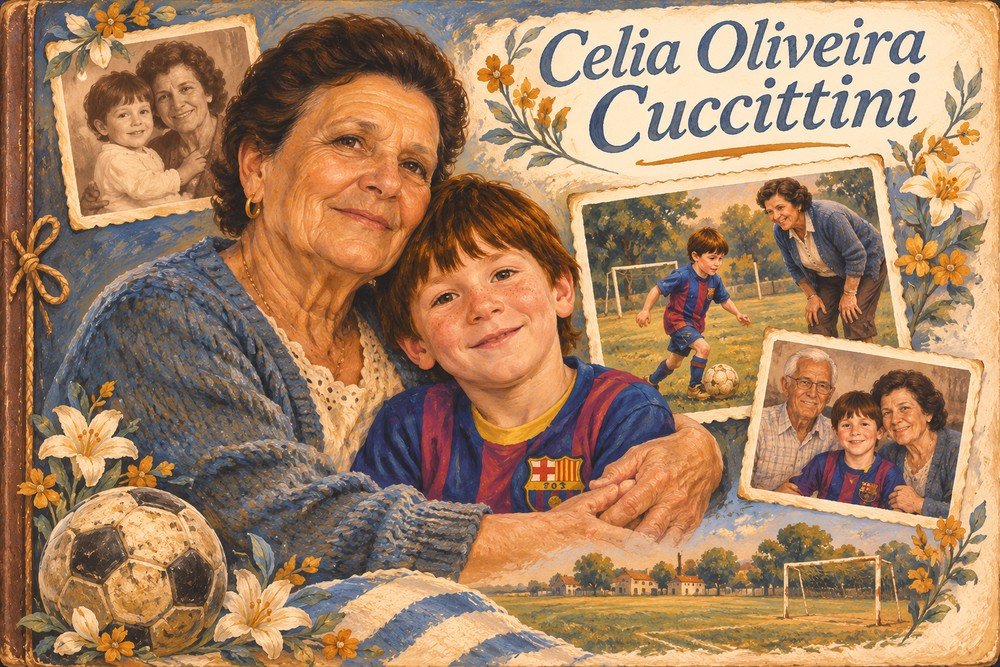
Long before Lionel Messi was a stadium name, his football life was local and small: a child in Rosario, a neighborhood club, and adults deciding whether to let him join a game. Celia Oliveira Cuccittini, his maternal grandmother, is remembered in that origin story as the person who insisted the little boy deserved a chance. Her biography is largely a family story, but its emotional center is clear: early encouragement before fame made the outcome seem obvious.
The Celia Oliveira Cuccittini and the First Believer in Messi account identifies her by the fuller name Celia Ramona Olivera Moyano and places her birth in Santa Fe, Argentina, on May 26, 1930. She married Antonio Cuccittini Caporissi in 1959, and their daughter, Celia María Cuccittini, was born the following year. Celia’s public profile was not built around a profession or celebrity. The importance attributed to her comes from her close place in the family and her presence in Lionel’s earliest football years.
The best-known recollection concerns Abanderado Grandoli, a neighborhood club in Rosario. Accounts vary on exact details, including Lionel’s precise age, but the recurring version is that a player was needed and the coach hesitated to use a very young, small child. Celia pressed for him to be allowed onto the pitch. He reportedly scored twice. The episode is powerful because it is ordinary in scale: a grandmother advocating for a child at a local match, not a grand plan for a global career.
That distinction is worth preserving. A remembered match does not establish that Celia predicted exactly what Messi would become, and retrospective stories can sharpen over time. It does show how family members may recognize a child’s enthusiasm and abilities before institutions do. In football, access to a first opportunity can matter. A young player needs a team, a ball, time to practice, and someone willing to believe that a small frame does not rule out skill.
Celia’s encouragement is also described in practical terms: taking Lionel to football, supporting his participation, and helping with his early equipment. These details are not glamorous, yet they show the daily labor behind a childhood interest. Young athletes depend on adults for transport, schedules, and reassurance as much as for praise. In this story, her influence is presented as attentive and persistent, grounded in family life rather than public ambition.
Messi was born in Rosario in 1987. His grandmother died in May 1998, when he was about ten, before the years of professional success that would make his name known worldwide. The loss therefore belongs to a childhood period, not a later public chapter. Accounts of Messi’s affection for Celia and his familiar upward gesture after goals have kept her memory linked to his career. The gesture is widely understood as a tribute, although the most meaningful account remains the personal bond rather than symbolism alone.
The subsequent achievements—Barcelona, Argentina, and major international honors—can make the beginning appear inevitable. It was not. At the time, a boy was simply playing in his neighborhood, and a relative was backing him. Celia’s legacy can be described without claiming that she alone created a champion: she was one of the early adults who helped make room for him to play. That is a human contribution, not a tidy success formula.
Her life also reminds readers that family members connected to famous people remain people in their own right. Celia had a household, a marriage, and a daughter; she lived privately in Argentina. The surviving public narrative is narrow because her own public career was not the source of later attention. Careful writing should resist inventing additional details about her personality or circumstances just to make the story more dramatic.
For the football context, the FIFA account of Messi’s Argentina career provides an independent reference point for the scale of the achievements that came much later. Set beside that record, the Grandoli recollection brings the story back to its human beginning: a child’s opportunity, a local field, and a grandmother who spoke up.